
Avoiding Penalties: Why Right to Work Checks Matter
For UK employers, Right to Work (RTW) checks are more than an administrative requirement. They are a critical legal safeguard designed to prevent illegal working and help organisations demonstrate compliance with immigration legislation.
In sectors such as construction, where businesses often manage large, mobile workforces and complex subcontractor networks, maintaining effective RTW controls is essential. Failure to verify a worker's eligibility can expose organisations to significant financial penalties, operational disruption, andZ reputational damage.
As regulatory enforcement continues to evolve, employers are under increasing pressure to demonstrate that robust workforce compliance processes are in place and consistently applied.
Understanding Employer Responsibilities
UK employers have a legal responsibility to confirm that every individual they engage has the right to work in the United Kingdom before employment begins.
When the prescribed Right to Work checking process is completed correctly, employers may establish what is known as a statutory excuse. This can provide protection against civil penalties if it is later discovered that an individual did not have permission to work.
However, where checks are not carried out correctly—or cannot be evidenced—organisations may face substantial consequences.
The Cost of Non-Compliance
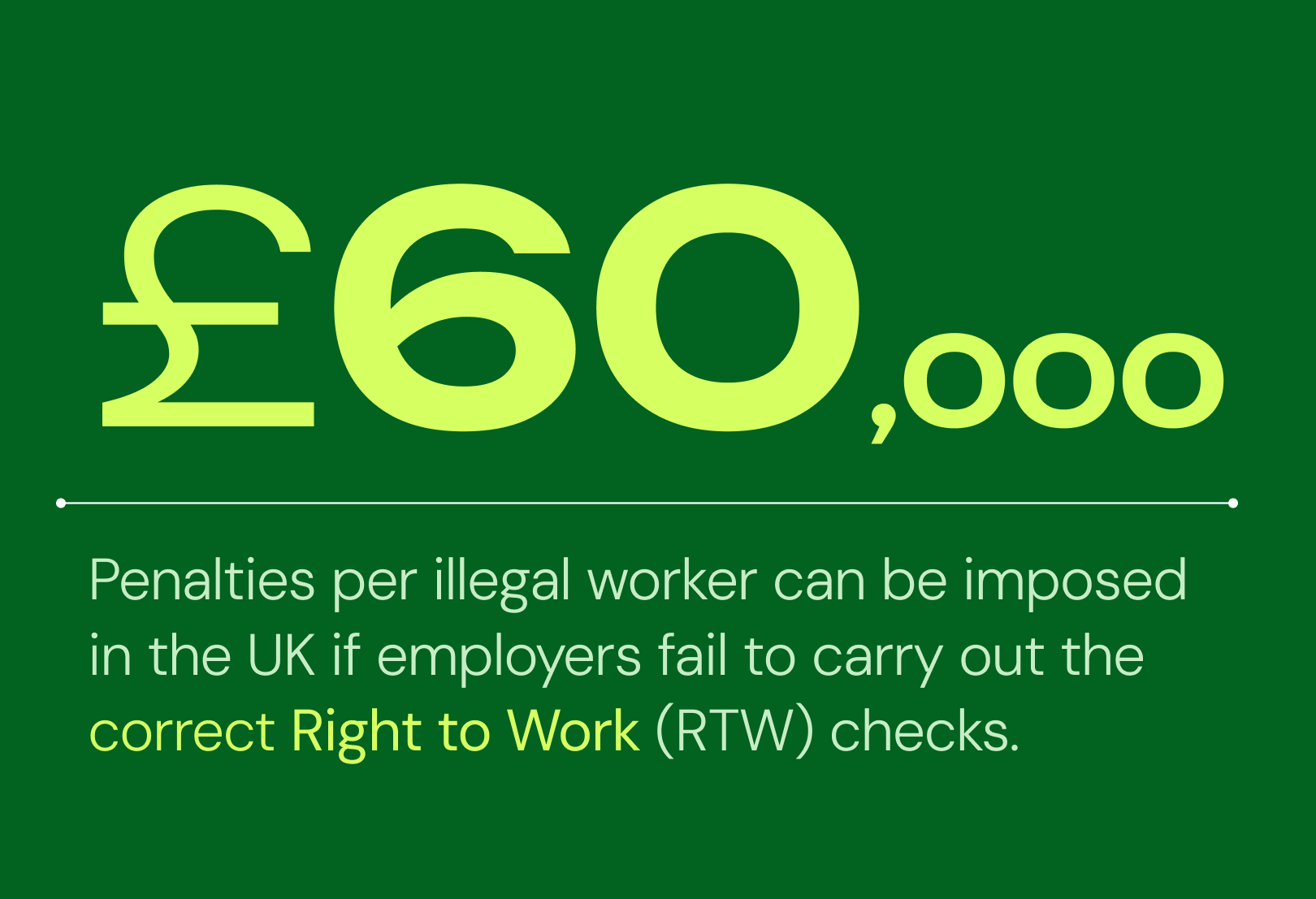
The financial impact of non-compliance has increased significantly in recent years. Employers found to be employing individuals without the appropriate right to work may face civil penalties of up to £60,000 per illegal worker for repeat breaches.
Beyond financial penalties, organisations may also experience:
Regulatory investigations and increased scrutiny
Disruption to workforce availability and project delivery
Loss of client confidence and commercial opportunities
Damage to organisational reputation
Increased compliance costs and remediation activity
For businesses operating in regulated environments, these consequences can extend well beyond the initial enforcement action.
Why Manual Processes Create Risk
Many organisations continue to rely on manual document collection and verification processes. While these methods may appear sufficient, they often introduce operational challenges and increase the likelihood of human error.
Common issues include:
Inconsistent verification procedures
Missing or incomplete records
Difficulty tracking follow-up checks
Limited visibility across multiple sites and contractors
Challenges demonstrating compliance during audits
As workforce numbers grow, maintaining consistency through manual processes becomes increasingly difficult.
Moving Towards Digital Workforce Compliance
Digital verification solutions help organisations improve the accuracy, consistency, and governance of their Right to Work processes.
By automating verification workflows and centralising compliance records, businesses can strengthen oversight while reducing administrative burden.
Effective digital compliance solutions support organisations by:
Verifying worker eligibility through secure digital processes
Maintaining auditable records of compliance activity
Providing greater visibility across workforce compliance status
Supporting ongoing monitoring and compliance management
Integrating workforce verification with wider operational processes
The result is a more controlled and efficient approach to workforce compliance.
How PPAC Supports Right to Work Compliance
PPAC helps organisations strengthen their workforce compliance framework through PPAC-ID and Compliant101.

Together, these solutions support the verification, management, and monitoring of workforce credentials, helping businesses maintain visibility over worker eligibility and compliance status throughout the worker lifecycle.
Key capabilities include:
Digital Right to Work verification
Centralised management of identification and certification records
Real-time compliance visibility
Integration with workforce and site access management processes
Comprehensive audit trails to support compliance reviews and inspections
By embedding compliance directly into operational workflows, organisations can reduce administrative effort while maintaining stronger governance controls.
Building a More Compliant Workforce
Right to Work checks remain one of the most important components of workforce compliance in the UK. As enforcement activity increases and supply chains become more complex, organisations must be able to demonstrate that appropriate controls are in place to verify worker eligibility and maintain compliance.
A proactive approach to Right to Work verification not only helps reduce regulatory risk but also strengthens workforce integrity, supports operational efficiency, and reinforces trust with clients and stakeholders.
For organisations seeking to improve compliance outcomes, digital verification and workforce compliance management are becoming essential tools for maintaining confidence in an increasingly regulated environment.

Author
Dean Tuhey
Dean Tuhey is the founder of PPAC Solutions and the driving force behind the Compliant101 platform. He started PPAC in 2016 after more than a decade building and running workforce staffing businesses serving construction clients across the UK, Europe and further afield, and before that spent years in construction consultancy, major projects business development and operations management. That grounding in how sites actually hire and mobilise people shapes PPAC's approach to identity verification, right to work and skills card validation.
